Reporting
Reports That Open
Anyone can render a balance sheet. The question that matters is what happens when someone asks where a number came from — and whether you can still produce the version you sent last quarter.
Every Number Opens
The four GAAP statements — including changes in equity — generate from the ledger with prior-period comparatives.
Every figure on every statement opens into the journal entries behind it, and from there into the invoice, bill or payment that caused them.
A line on the income statement opens into the accounts behind it, an account opens into its entries, and an entry opens into the invoice, bill or bank transaction that caused it. Not as an export you reconcile by hand afterwards — as the way you read the statement.
This is the difference between answering an auditor’s question in the meeting and promising to come back on it.
The statements are prepared under US GAAP, the one reporting framework Automate Accounting supports. IFRS reporting is not offered.
As of When
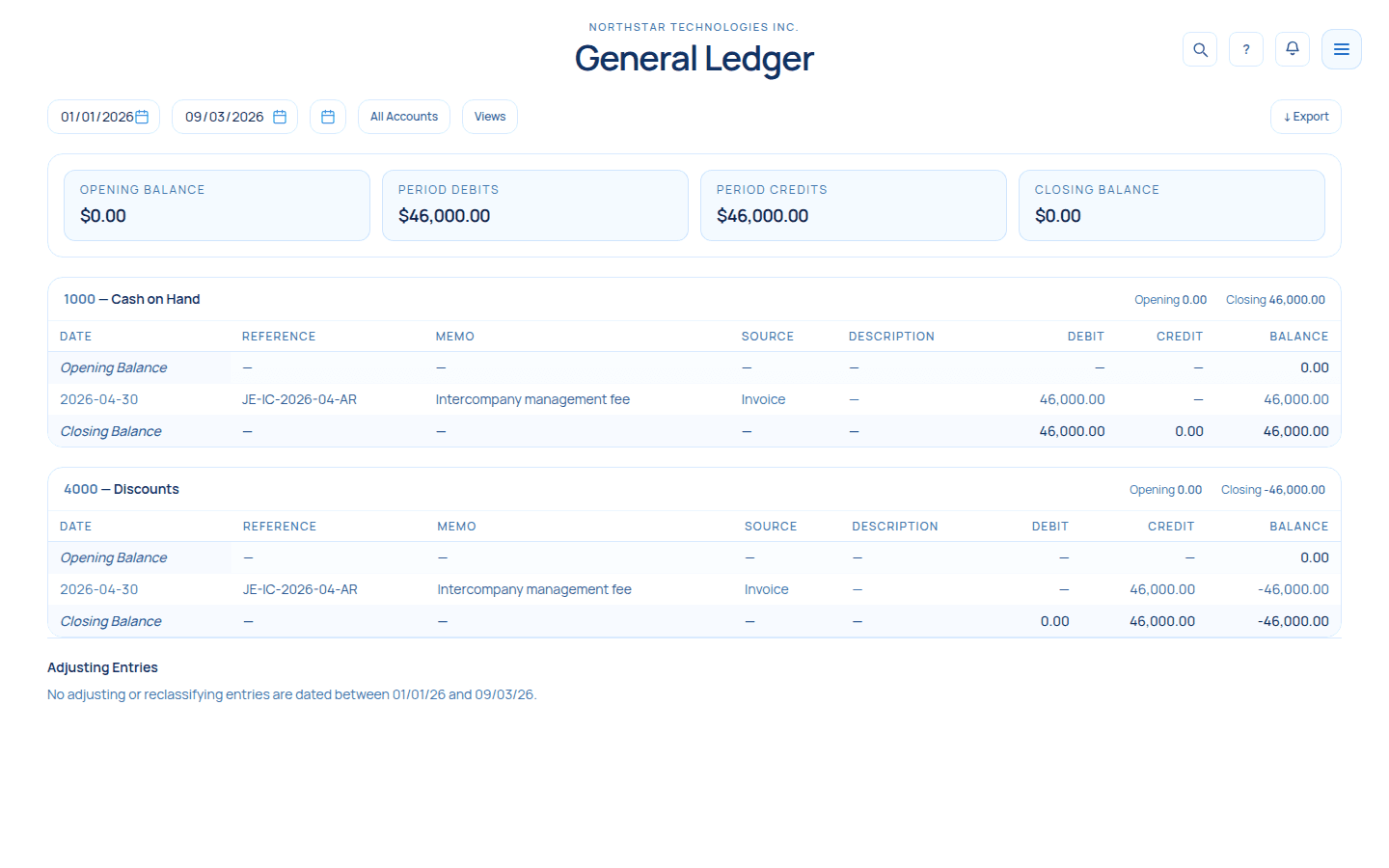
Every report takes an as-of date, so you can reproduce what the books said on the day you reported them rather than only what they say now.
Reports that only show current state cannot answer the question every external reviewer asks, which is what the books said when you reported them. An as-of date is on every report here, so last quarter’s balance sheet is something you regenerate rather than something you hope somebody saved a PDF of.
Multi-Entity, From the Real Ledgers
Multi-entity consolidation rolls up each company's real books, with intercompany eliminations and access controlled company by company.
Consolidated statements are built from each entity's real ledger, with intercompany eliminations and the consolidating schedule that shows how the total was reached.
Consolidation runs on each entity’s actual ledger rather than on manually entered trial-balance summaries, with intercompany eliminations between entities and a consolidating schedule showing how the total was reached. Column by column, the way the reviewer wants to see it.
Issued Is a Fact, Not a Memory
Every pack you issue is recorded with a unique seal, so you can say exactly what you sent, when, and prove it has not changed since.
Reissuing a statement supersedes the earlier one on the record instead of replacing it, so a recipient holding the old version can still be told exactly what changed.
When you send a statement to a lender it goes on a register with a unique seal of exactly what was sent. Reissue it and the earlier version is superseded on the record rather than overwritten — so the recipient holding last month’s copy can be told precisely what changed, and neither of you is relying on an email thread to reconstruct it.
The Whole Package, On One Click
A complete due-diligence package, with statements, ledgers, agings and evidence, produced as a snapshot of one moment in time and carrying a seal anyone can check.
Statements, trial balance, general ledger detail, AR and AP aging, bank reconciliations, the fixed-asset schedule, the chart of accounts, the journal listing, the supporting documents and the control attestations — assembled as one package, sealed, and recorded as delivered to a named recipient for a named period.
It is the same process whether the recipient is a bank, an investor, an external auditor or you on your way out.
The recurring version — a monthly pack for the bank, the investors or the board, on their calendar, with covenant certificates and a nightly re-check of every copy you sent — is on the stakeholder reporting page.
What a package cannot prove, yet
A recipient can now check a package without us: every one carries a small program that recomputes each file’s fingerprint on their own machine and reports whether anything has changed. It contacts nothing and installs nothing.
What it cannot establish is that we sealed an honest package in the first place — no check that travels inside an artifact can. Closing that needs a signature from a party we do not control — and every package now carries one, which the recipient checks with standard tools against a certificate fetched from that authority rather than from us. The Verifiable Books page sets out exactly what each half proves.
The protections underneath all of this are on the Trust Center.