The Close
A Checklist You Can't Tick Your Way Past
Most close checklists are a list of promises. This one is computed from the ledger: an item is done when the condition behind it is actually true, and not before.
The Problem With Close Checklists
A close checklist in a spreadsheet records that somebody said the bank was reconciled. It has no idea whether the bank is reconciled. The gap between those two things is where every restated month lives — and it is invisible until an auditor pulls the thread months later, by which point the person who ticked the box has left.
The fix is not a better checklist template. It is deriving the state from the books themselves, so that the checklist has nothing of its own to be wrong about.
Readiness Is Computed, Not Claimed
Close readiness is read from the books themselves, so a step cannot be ticked off while the work behind it is still undone: unposted entries, unreconciled accounts, subledgers that don't tie.
Every balance-sheet account is substantiated against its supporting detail, with the difference and its age carried on the reconciliation rather than left for someone to notice.
Period-over-period movements are explained inside the close, so the question an auditor asks in March is answered in the month it happened.
Unposted entries, unreconciled accounts and untied subledgers are read from the ledger each time you look. There is no state to update and therefore no state to forget to update: if somebody posts a late journal after you marked a section complete, the section stops being complete on its own.
Sign-Off, Then Lock — In That Order
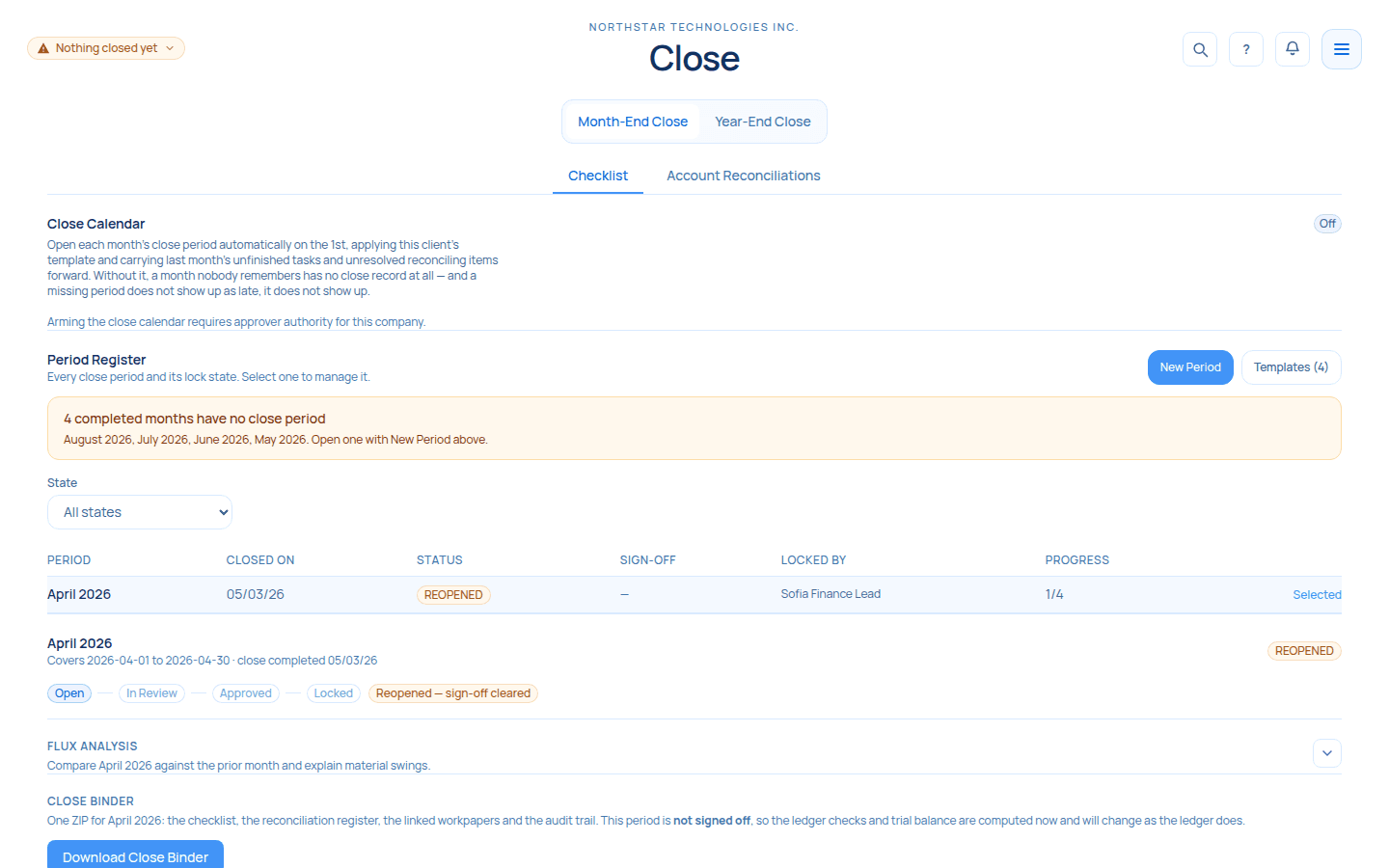
A period is signed off by a named approver before it can be locked, and reopening it revokes that sign-off — so a lock always stands on an approval somebody gave.
A closed period is locked at the point of entry: anything dated into it is refused outright, not flagged for someone to notice later.
A locked period refuses new entries at the foundation, not just on the screen, so nothing gets in through an import, a connected system or a scheduled task either. Reopening a period is a deliberate, recorded act that revokes the sign-off — which means a locked period always stands on an approval somebody actually gave, rather than on one given before the last three corrections.
Year-End Is the Same System, Not a Second One
Year-end close posts a real, balanced entry that closes the P&L into retained earnings — and a correction booked afterwards is folded in, not lost.
Closing a year posts a real, balanced entry rolling the P&L into retained earnings, and a correction posted into a closed year is folded into a separate, dated adjustment rather than quietly rewriting the original. The prior year keeps saying what it said.
How Long It Actually Took
How long each close actually took is measured from the record, not self-reported, so the trend is a fact about your process rather than an impression of it.
Cycle time is measured from the record of the close itself. If the first three days are spent chasing one entity’s bank feed, that is visible as a fact rather than as a feeling, which is the only basis on which a close gets shorter.
What this does not do
It does not close the books for you. Somebody still has to reconcile the accounts that do not reconcile themselves, explain the movements that need explaining, and decide the period is right. What it removes is the part where you find out in March that a box was ticked in January and shouldn’t have been.
The close rests on the ledger underneath it — how that ledger works is the page to read next, and reporting is what a closed period turns into.