On Top of Your Accounting System
Keep your accounting system. Add what it can’t do.
Automate Accounting is the reporting, analytics and delivery layer on top of the system you already run — QuickBooks Online directly, anything else through the exports it already produces. Monthly packs for your bank and investors, covenant certificates, a due-diligence package a buyer can verify, and audit evidence that is ready before the auditor asks. When you are ready, it can be the system of record too.
Three Things Your Accounting System Was Never Going to Do
Most accounting systems stop at the trial balance. Everything a bank, an investor, a buyer or an auditor asks for after that point is assembled by hand, from an export, by the person with the least time for it. That assembly is what this replaces.
The people who need your numbers
Your bank, your investors and your board each get their own pack, on their calendar, as a link that expires — with covenant certificates computed from the books, and every delivered copy re-checked nightly against the ledger it came from.
Stakeholder reporting →Selling your company
When a buyer's request list arrives, answer with a folder: a due-diligence package already built, sealed at one moment in time, filed into a data room, and verifiable byte for byte by the person you sent it to.
Due diligence →Preparing for and passing an audit
A readiness score kept all year, the tests an auditor runs already run over the ledger, controls with signed attestations, and an engagement the auditor works through one link.
Audit readiness →One generation produces three ready-to-send packages, for management, your bank and your investors, each holding only what that audience should see.
A complete due-diligence package, with statements, ledgers, agings and evidence, produced as a snapshot of one moment in time and carrying a seal anyone can check.
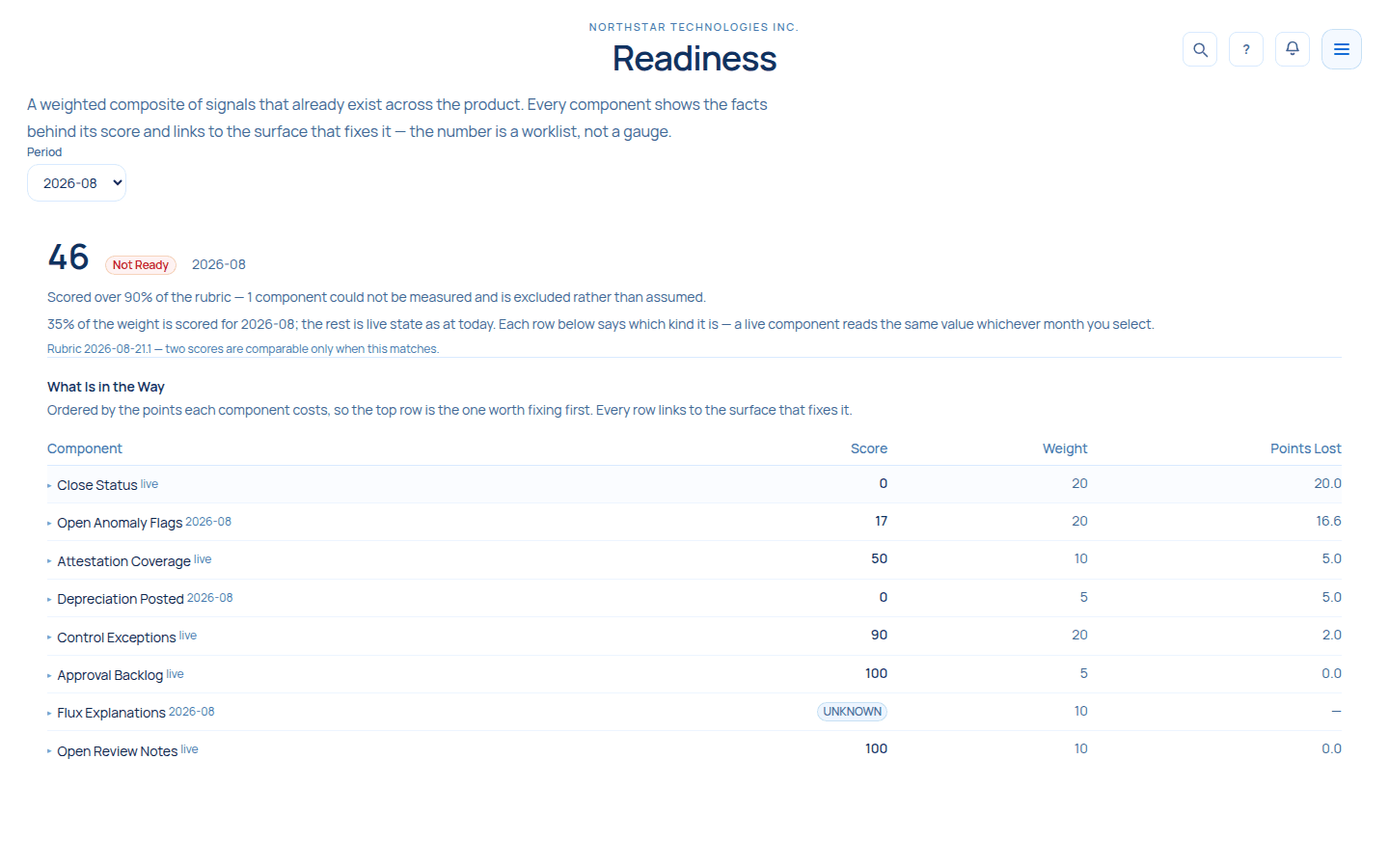
A readiness score answers whether the books could go to an auditor today, from eight signals: open anomalies, unexplained movements, control exceptions, attestation coverage, close status, depreciation posted, approval backlog and open review notes. It refuses to show a number when too little has been measured.
How It Sits on Top
Your system stays the place money moves from. This is where the numbers get explained, packaged, sealed and sent — and every package says which figures came from where.
You can keep your current accounting system as the system of record. Switch that on for a company and Automate Accounting imports, reports, closes and packages on top of it, and declines to move money in a book it does not own, so a bill is never paid twice.
From QuickBooks Online, the accounts, customers, vendors, invoices, bills, payments, deposits, purchases and the general ledger all come across, every hour, and a change made back in QuickBooks is picked up rather than missed.
Any accounting system that can export a trial balance, a ledger, or open invoices and bills can feed it. Imports are checked before anything is written, previewed as a difference, and can be rolled back.
Three Things You Can Check Yourself
The system itself refuses an unbalanced entry before it can be saved. The rule is built into the foundation, not into a screen that can be bypassed.
Close readiness is read from the books themselves, so a step cannot be ticked off while the work behind it is still undone: unposted entries, unreconciled accounts, subledgers that don't tie.
Every posting, whether yours, a rule's, or an automation's, goes through the same single door, with the same approvals and the same ability to reverse it.
When You Are Ready, It Is the Whole System Too
The layer is not a bolt-on. Underneath it is a complete accounting system built for companies that outgrew QuickBooks and are not interested in an ERP project — and once the books you have been reporting on here are the books you would rather keep here, the switch is one recorded decision.
What you outgrew
Multiple entities in multiple files. Revenue recognition in a spreadsheet. No approval trail worth the name.
The multi-entity case →What you were offered
A six-figure implementation, a consultant, and nine months before anyone closes a month in it.
How we compare →What this is
Mid-market capability with small-team gravity. Start on top of your system today; move the books when a parallel month says so.
Moving your books →Multi-entity consolidation rolls up each company's real books, with intercompany eliminations and access controlled company by company.
Revenue recognition runs on contracts and performance obligations in the system, not on a spreadsheet somebody maintains beside it.
The four GAAP statements — including changes in equity — generate from the ledger with prior-period comparatives.
What’s Shipped, What’s Building, Where It’s Going
Most vendors blur those three together and let you sort it out during the evaluation. We label every claim on this site, and the labels are generated from the claim itself — so a roadmap item cannot quietly lose its label on the way to a sales page.
Shipped — running today
History is never overwritten. Every record is sealed to the one before it, and a correction is a new entry that reverses the old one, so the original stays in the books.
Every company's records are kept separate at the foundation of the system, across 200+ kinds of record, not by a filter the software has to remember to apply.
Every pack you issue is recorded with a unique seal, so you can say exactly what you sent, when, and prove it has not changed since.
A recipient checks a delivered package on their own computer, with a tool that travels inside the package, installs nothing and contacts no one.
An independent timestamp authority attests that a package existed on the date it claims. The recipient checks that attestation with standard tools, against a certificate fetched from the authority rather than from us — so the last step of the proof rests on someone we do not control.
Every night, every pack you have delivered is re-checked against the books. If the numbers underneath it have moved, that pack is flagged and you are told, before your lender notices.
You can ask not just what the books say now, but what they said on any date since the books were opened here — and see exactly what changed between the two.
Building
Empty today — everything that was here has shipped, the last of it on 4 September 2026. The next thing we commit to will appear here, labelled, before it appears anywhere else on this site. The full roadmap says what governs that.
Where this is going
The destination is routine accounting work that runs itself, through the same approvals and the same ability to undo that a person is held to.Where this is going
We publish direction, not dates, and we don’t sell what isn’t shipped. The full roadmap → · Why we think this is a category →
And If You’d Rather Not Do It Yourself
Accounting Advisor is an accounting practice under shared ownership with the company that builds this software. It can review your close, prepare it alongside you, or run it. It is a separate legal entity, it is entirely optional, and nothing in the product is unlocked by engaging it.
An Accounting Firm Closes Real Books on This Every Month
Accounting Advisor is a working practice under shared ownership with the company that builds this software, and it keeps its own books here. It is a separate legal entity, it is optional, and we explain the whole arrangement rather than leaving you to find it.